
- Joined
- Feb 3, 2022
- Messages
- 8,700
- Reaction score
- 6,702
Nordie you're one cute hoor. You didn't write a word of that!


Not just Scholairbocht, he pretty much paraphrased what I have been saying.Please show Bocht some respect. He has displayed considerably more expertise on this subject than you Sir.

the link, highlighted in blue, included in the article, takes your straight to Vox Day's site.Nordie you're one cute hoor. You didn't write a word of that!

Ive already said this before. Perhaps you are copying your homework.Not just Scholairbocht, he pretty much paraphrased what I have been saying.
I figured. The military talk was a bit more complicated than you'd expect from a veteran Óglach from South Armagh Brigadethe link, highlighted in blue, included in the article, takes your straight to Vox Day's site. And I know you didnt write it as there is nothing at all about Peter or Jane and not even one picture.


Once again we are confronted by the spectre of US meddling and aggresion which leads to countless wars and disputes.Good essay on the why's and context of the conflict
The war on Iran and the logic of pushback | Al Mayadeen English https://share.google/QtG4gspuYziwPs0IA


Yep.Everyday is a good day to Kill Islamic Nutters ! ! !
Why waste any day when Every Day is a Good Day to Kill Islamic Nutters ! ! !

They are actually very poor at killing one another ! !Yep.
The only good raghead is a dead raghead.
Same with the jew.
It's a win win for humanity.
Well the jew boys are good at sniping brown children from 1000 yards....They are actually very poor at killing one another ! !
They need to kill a lot more Adult Islamic Nutters = = A lot more ! ! !Well the jew boys are good at sniping brown children from 1000 yards....
We can only hope that Greta has discovered Cock and likes it ! ! !Where's Greta of Thunberg while this environmental vandalism is going on?
Remember how all world leaders (apart from Trump) bowed before that freak?
How dare they ignore what's going on environmentally with their Uki proxy war against Russia now?
Kiev’s attacks on Russian refinery cutting global oil supply – Kremlin
The infrastructure in Tuapse, which has been repeatedly attacked by Ukrainian drones, was used for exports, spokesman Dmitry Peskov has said
Published 28 Apr, 2026 13:00 | Updated 28 Apr, 2026 14:05
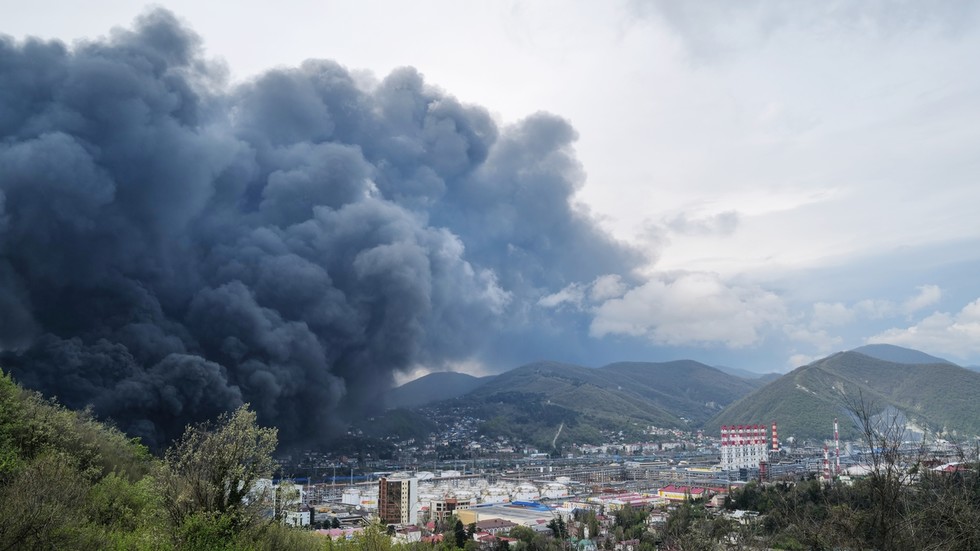
Smoke rising over Tuapse, Russia, following Ukrainian drone strikes, on 21 April, 2026. © Sputnik/Boris Morozov
Ukrainian drone strikes on Russia’s energy infrastructure on the Black Sea coast are worsening the global oil crunch caused by the US-Israeli war on Iran and disruption in the Strait of Hormuz, Kremlin spokesman Dmitry Peskov has said.
Multiple Ukrainian drone strikes have hit Tuapse, a key densely-populated port in Russia’s Krasnodar Region, have targeted its refinery and adjacent marine terminal. Regional governor Veniamin Kondratyev reported fires at the site, including a major blaze at the refinery, prompting evacuations of nearby residents and emergency response measures.
The attacks led to high-risk air pollution, with residents advised to use respirators, as an oil spill destroyed miles of the beach in the resort town. Kondratyev also released a video of the town filled with smoke, with a clean-up operation ongoing on the beach.
Speaking to reporters on Tuesday, Peskov confirmed that Russian President Vladimir Putin had been briefed on the situation. “The Kiev regime has once again struck oil storage facilities, where the oil was intended for export operations, that is, for fulfilling export contract obligations,” he said.
Peskov stressed that the Ukrainian drone raids “further increase the oil deficit on global markets, which are already experiencing significant difficulties because of the situation in the Strait of Hormuz, and provoking further destabilization on global energy markets.”
The US-Israeli war on Iran led to a de-facto closure of the Strait of Hormuz, which handles roughly 20% of global oil consumption, sending benchmark Brent oil prices up well beyond $100 per barrel. To alleviate the pressure on oil markets, the Trump administration went so far as to issue a sanctions waiver on Russian oil already at sea.
Russian Foreign Ministry spokeswoman Maria Zakharova said the attacks on Tuapse caused civilian casualties and damage to homes, social infrastructure, and environment and criticized a lack of response from the EU and NATO.
“What are the European Union and NATO saying about this? They are silent,” she charged. “There is a serious environmental threat. The pollution is covering 10,000 sq. m. Where are these Western environmentalists?
Ukrainian strikes on Tuapse deepen global oil supply crunch, the Kremlin warns
Ukrainian drone raids on Tuapse oil sites destabilize energy markets amid the Iran war and Hormuz crisis, spokesman Dmitry Peskov has saidwww.rt.com
Ya'd want to be a proper Pervert to ride that dog....We can only hope that Greta has discovered Cock and likes it ! ! !
Zelensky's main fear must be that should he be disposed then the corruption will catch up with him as he will no longer be in a position to sweep it under the carpet.Zitler is in the shit......
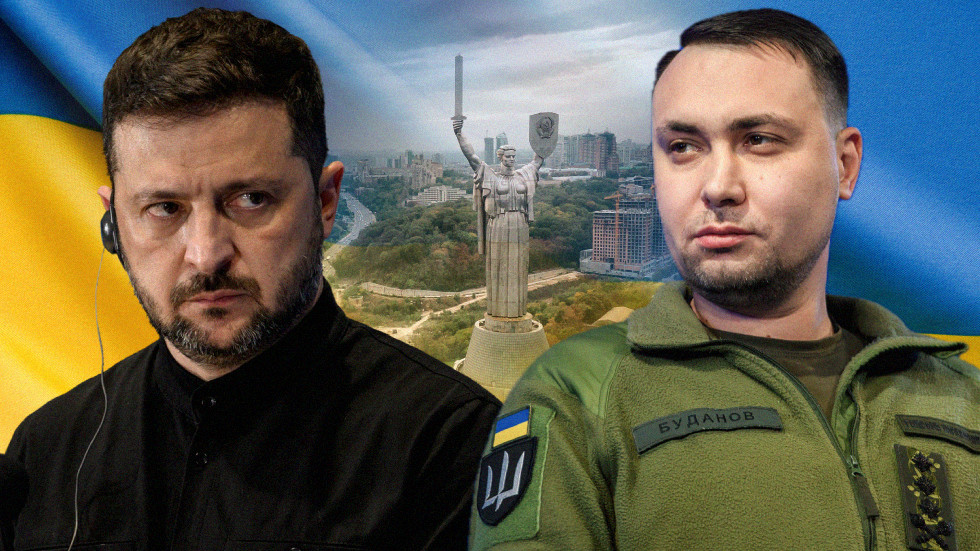
Knives out: Is a coup brewing in Kiev?
Ukraine’s power appears to be shifting behind the scenes
Published 27 Apr, 2026 19:05 | Updated 27 Apr, 2026 21:18
By Vitaly Ryumshin, journalist and political analyst
Almost six months have passed since ‘Mindichgate’ erupted in Ukraine. The corruption scandal, which allegedly implicated large parts of the ruling elite, became the most serious political test of Vladimir Zelensky’s presidency and, for a time, threatened to bring it to an abrupt end.
To stabilize his position, Zelensky was forced into concessions. His long-time ally Andrey Yermak was removed, and in his place came Kirill Budanov, head of Ukraine’s Main Intelligence Directorate (GUR), a figure widely seen as a moderate critic of the president. The cabinet was also reshuffled, with new figures brought in to broaden the coalition. In return, anti-corruption bodies such as NABU and SAPO eased their pressure on the president.
The immediate crisis has subsided. But the structure of power in Ukraine has shifted significantly. The clearest sign of this transformation is the rise of Budanov.
Initially, the new head of the presidential office kept a low public profile. Over time, however, he has grown more confident, and more visible. Throughout April, Budanov appeared to walk a careful line in his public statements, often striking a tone at odds with Zelensky himself.
While the president has prepared the country for a prolonged conflict, Budanov has spoken of ongoing negotiations and suggested that peace may not be as distant as many assume. When Zelensky highlighted Ukraine’s technological breakthroughs, Budanov has downplayed them. He has also openly acknowledged the growing difficulties of mobilization, a rare admission from a senior official in a country at war.
At the same time, Budanov has been carefully constructing his public image. In Western media, he is presented as both a war hero and a pragmatic “dove,” a man who understands the need to bring the conflict to an end. For domestic audiences, his team promotes stories of personal bravery, portraying him as a hands-on commander who has taken part in operations and narrowly escaped danger.
The result is a carefully balanced political persona, and one that increasingly resembles that of a future president.
Budanov’s ambitions are hardly a secret in Kiev. His approval ratings reportedly rival those of Valeriy Zaluzhny, once seen as Zelensky’s most serious potential rival. Unlike Zaluzhny, however, Budanov remains firmly embedded within the system. He is said to have cultivated connections abroad, including with figures in Donald Trump’s political orbit, while at home he enjoys support among influential members of the ruling Servant of the People party.
For Zelensky, bringing Budanov into the inner circle may have seemed a logical move. Where Zaluzhny was sidelined and sent abroad, Budanov was co-opted in an application of the old principle: keep your friends close, and your enemies closer. In theory, this should allow the president to monitor potential dissent within the elite.
In practice, it has created a new risk. By elevating Budanov to the centre of power, Zelensky has given him both visibility and institutional leverage. The head of the presidential office is no longer a background figure but a key political actor, one capable of shaping narratives and, potentially, alliances.
The fault line may emerge over the question of negotiations with Russia. As the conflict drags on and the situation at the front becomes more difficult, a growing segment of the Ukrainian elite appears to favor some form of compromise. This sentiment increasingly clashes with Zelensky’s public stance.
History offers many examples of how such tensions can unfold. When a leadership persists in a course that significant parts of the elite consider untenable, pressure builds. Initially, this may take the form of calls for a change in direction. But in more acute cases, it can lead to demands for the leader himself to step aside, or to more drastic outcomes. This is what is often described as a ‘palace coup.’
Until recently, such a scenario in Ukraine seemed unlikely. There was no obvious figure capable of uniting the disparate factions and presenting a credible alternative. Zaluzhny, for all his popularity, has withdrawn from the political arena.
Budanov, however, may fit the role. He’s ambitious and not entirely controllable, and he’s positioning himself as a bridge between different camps, particularly those who see the need for a negotiated end to the conflict. In that sense, he could become a focal point for elite dissatisfaction.
The question, then, is no longer whether internal tensions will intensify, but how far they may go, and how quickly.
For Russia, the outcome may matter less than the process. Whether Zelensky, Budanov, or another figure occupies the presidential office, Kiev’s political class remains broadly hostile to Moscow. From a pragmatic standpoint, the key issue is policy and personalities are a secondary concern.
If a future leadership, whether by design or necessity, proves more willing to bring the conflict to an end on terms acceptable to Russia, then that, ultimately, will be the decisive factor.
Budanov’s rise turns Zelensky’s inner circle into Ukraine’s new power struggle
As Zelensky faces pressure over war strategy and corruption fallout, Budanov is emerging as a powerful insider with presidential-style ambitions
Lie back and think of the Planet ! ! !Ya'd want to be a proper Pervert to ride that dog....
To be honest, thats the kind of environmental disaster I can get behind! Burn it to the ground!Lie back and think of the Planet ! ! !
Legend has it ~ ~ If Greta Thunberg has a Sexual Orgasm = = The Planet Ends !To be honest, thats the kind of environmental disaster I can get behind! Burn it to the ground!
I'll also note, Russia is now totally defenseless. I think oil buyers will have to go elsewhere.

We're safe enough so.Legend has it ~ ~ If Greta Thunberg has a Sexual Orgasm = = The Planet Ends !
Legend has it ~ ~ If Greta Thunberg has a Sexual Orgasm = = The Planet Ends !
 www.theguardian.com
 oilprice.com
She is likely to be taken advantage of and used in matters of the heart as she has been since her adolescence.We can only hope that Greta has discovered Cock and likes it ! ! !
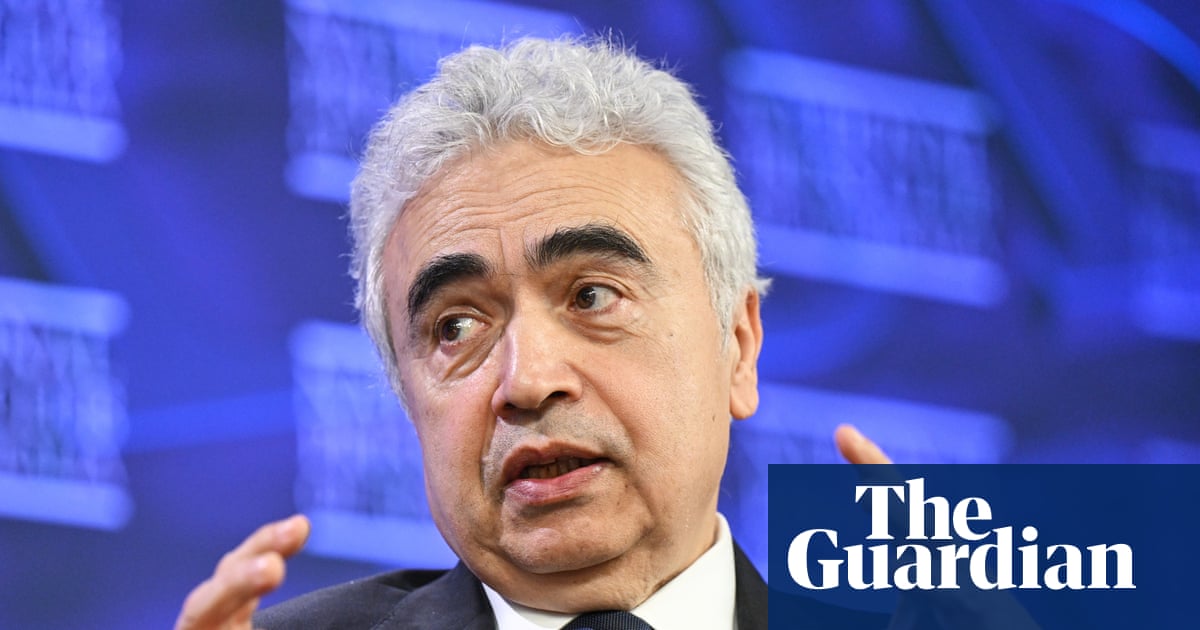
The IEA is a total waste of space with Birol being the arse lickers arse licker.Retards really do believe any old shite.
Of course if the Perverts who pushed their proxy war against Russia were executed we would have plenty of cheap and reliable energy throughout Europe.
But will the world actually end at last?Stress in Ireland soon
Cartels always suffer internal tensions, hopefully other elitist clubs will also start to erode away, the EU and the NWO being two that are due for extinction.Tha UAE has walked out on OPEC, wanting the freedom ro sell as much of its own oil as it wishes, it'll help plug the gap left by the Hormuz blockade.


It will radically change anywayBut will the world actually end at last?


