- Joined
- Jan 26, 2024
- Messages
- 288
- Reaction score
- 345
No idea Myles. The professionals looking after him must decide, in their wisdom, to leave him without clothing. I think they should have sought a second opinion.Why is he naked Madam?

No idea Myles. The professionals looking after him must decide, in their wisdom, to leave him without clothing. I think they should have sought a second opinion.Why is he naked Madam?

Checking for belt explosives on the person.No idea Myles. The professionals looking after him must decide, in their wisdom, to leave him without clothing. I think they should have sought a second opinion.
The should have put him in a Bacon Wrap !No idea Myles. The professionals looking after him must decide, in their wisdom, to leave him without clothing. I think they should have sought a second opinion.


As I noted before, leftists are only leftists when it suits them, workers rights obviously do not enjoy their protection.I'll leave this here because I'm not sure where the examples of woke retardery thread is.
Fireman disciplined for allowing firemen to say ‘fireman’ loses unfair dismissal case https://share.google/uZPfI7GoNQF4uLf8W
Maybe Pig-Skin would do or better, bury the Islamic Nutters in Pig-Shit ! ! !It would take a whole Hog to wrap around that lardy arse fucker
Normally he would have been given at least a sheet. No one should have to see thatNo idea Myles. The professionals looking after him must decide, in their wisdom, to leave him without clothing. I think they should have sought a second opinion.
 . ..but they were mad and out of blankets. Now the whole world has seen what's under the bonnet and is rolling around laughing. No wonder they have to bully their females into submission. I mean i have seen more impressive baby carrots.. Clearly a humiliation thing - not that I blame the EMTs.
Mam, kindly consider the shock and the cold, neither are conducive to a display of pride.Normally he would have been given at least a sheet. No one should have to see that

You know what, I'd say that you think Morgan is the bee knees, sure doesn't he talk about the trannies in women's sports..Snitch posting more bullshit.
You mean like when BIlly Connolly and his classmates were forced into the north sea to swim and "we went in as boys but came out girls"?Mam, kindly consider the shock and the cold, neither are conducive to a display of pride.
The very same! Something similar happened to me many years ago when I was doing some diving training. Having broken the ice to get in to the lake the homemade wetsuit split along the crotch. Took a week or so for the then girlfriend to find it again! Good for the sperm count though, or so it is said!You mean like when BIlly Connolly and his classmates were forced into the north sea to swim and "we went in as boys but came out girls"?

The Banana 26 County state-let is a laughing stock !No wonder RUC plant Drew Harris did a runner......
Can't find anything on RTE/PRAVDA about it either.
Might just be Righty-O !Is he/she (far-right)?
I don't know
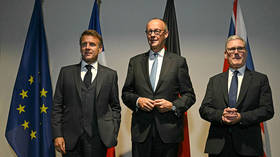
The weight of reality will be crushing for the clown elite.The heart of the cancer lies in Brussels.
It has to be removed.
Western Europe isn’t leading the world anymore, so it’s threatening it instead
The region’s insecurity is driving global instability
NATO leaders attend 2025 summit in the Hague © Getty Images / Ben Stansall - WPA Pool/Getty Images
Few serious observers of international politics doubt that Western Europe has once again become one of the world’s most dangerous sources of instability. It’s a bitter conclusion, given that the entire post-1945 order was built to stop the continent from dragging humanity into catastrophe a third time. Yet here we are: the loudest calls for confrontation come from west of the Bug River, and nowhere else do governments prepare for war with such nervous energy.
The hostility is directed above all at Russia, Western Europe’s neighbour and main trading partner for decades. Increasingly though, it spills toward China as well, despite the absence of any genuine political or economic conflict between the sub-continent and Beijing. That tells us something important. The source of today’s aggressive Western European posture isn’t external at all. It lies in the region’s own political structures, its confused sense of itself, and the growing panic of elites who no longer understand the world that has taken shape around them.
It would be deeply irresponsible to assume that American supervision of Western Europe will be enough to prevent disastrous miscalculations. After all, this part of the world has already given humanity two world wars. And we should never forget that the sub-continent contains two nuclear-armed states, Britain and France. Western Europe may no longer be the center of world politics, but it remains undeniably a place where a conflict could start that would engulf everyone.
The roots of its behaviour run deep. The first cause is internal. Since the mid-twentieth century, Western European societies have become unusually consolidated. Their elites have mastered the art of preventing domestic upheaval; social unrest, ideological revolt and large-scale political renewal have all faded away. Revolutions once shaped the region’s history. Now their very possibility has disappeared.
This creates a paradox. A political system that cannot change itself begins to project instability outward. Western Europe’s elites are tightly entrenched, even when they are painfully incompetent. Its societies are apathetic, convinced they have little influence over their own fate. Across the EU, individual governments may quarrel, but on the big questions, especially the approach to the outside world, they are strikingly unanimous. Mechanisms of conformity work so effectively that even the most reckless foreign-policy decisions attract little dissent. Western Europe has reached a point where individual thinking gives way to collective instinct.
In other words, the sub-continent has lost the ability to reinvent itself peacefully. And that internal stagnation is now spilling into its external behaviour.
The second major cause is Western Europe’s declining global position. For decades the region’s powers could afford a more measured diplomacy because its economic weight guaranteed respect. When these Europeans lectured the world, others listened. Not always happily, but they listened. Those days are gone. China’s meteoric rise, India’s emergence as a global player, Russia’s recovery and insistence on defending its interests, and the political awakening of the Global South have pushed the EU down the hierarchy of world powers.
The world has changed; Western Europe has not.
Suddenly, this bloc faces a landscape in which it is no longer the central actor, yet it knows no other way to behave. Throughout its history, Western Europe has never experienced being a peripheral region. Today it is edging dangerously close to that status, and its elites simply cannot process the shift. Hence the frantic attempts to attract attention by escalating military rhetoric and painting Russia and China as existential threats. If Western Europe can no longer command influence through economic or diplomatic power, it will try to do so through alarmism and the language of war.
The rise of groups like BRICS only strengthens the region’s anxiety. These Europeans once imagined the G7 as a vehicle for preserving their centrality by hitching themselves to Washington. BRICS demonstrates that the world can organize itself without the EU, and even against its preferences. No wonder these European leaders feel cornered.
Western Europe remains part of what Russians call the collective West, and its ties to the United States are strong. But these ties no longer deliver what the locals have come to expect: a guaranteed place at the top. The entire debate about the American “security umbrella” is really about something else. It is about Western Europe’s fear of losing status, and its desperate hope that the United States will keep treating it as a co-equal power. Washington, however, sees the world differently, and increasingly has its own priorities.
Taken together, these internal and external forces make Western Europe the most combustible player on the global stage as we enter the second quarter of the 21st century. This is not a problem created by one or two inept leaders, nor is it a passing mood linked to temporary economic pains. It is structural. That makes it far more dangerous.
What is the cure? At the moment, no one knows. History offers no comforting examples. When a formerly central power loses influence and cannot adapt, the outcomes have rarely been peaceful. Western Europe today is replaying this old script: locked into outdated assumptions, unable to reform itself, and convinced that the only way to stay relevant is to shout louder and brandish threats.
For Russia, China, and the United States, this situation creates a difficult challenge. Their choices will shape whether Western Europe’s new instability becomes manageable or erupts into something far worse. Ordinary citizens across the world have every reason to hope these decisions will be wise. But hope is not certainty.
What we can say with confidence is that Western Europe’s behaviour is not the product of strength, but of insecurity. A sub-continent that once dominated world affairs now sees others overtaking it. And instead of adapting to a multipolar order, it lashes out, insisting on a global role it can no longer sustain.
This is what makes Western Europe, tragically but unmistakably, an enemy of peace today.
The same as they did in 1914 and 1939.More euro bollox.
The weight of reality will be crushing for the clown elite.
It's fair to observe that they do not expect to suffer the consequences of the totally detached from reality decisions endorsed by themselves.
And the kicker.
Neither the means nor the capacity to do anything meaningful offensively is available.
The US is leaving their chat group.
So what now for the vassals.?
America's Gimps ! ! !The heart of the cancer lies in Brussels.
It has to be removed.
Western Europe isn’t leading the world anymore, so it’s threatening it instead
The region’s insecurity is driving global instability
NATO leaders attend 2025 summit in the Hague © Getty Images / Ben Stansall - WPA Pool/Getty Images
Few serious observers of international politics doubt that Western Europe has once again become one of the world’s most dangerous sources of instability. It’s a bitter conclusion, given that the entire post-1945 order was built to stop the continent from dragging humanity into catastrophe a third time. Yet here we are: the loudest calls for confrontation come from west of the Bug River, and nowhere else do governments prepare for war with such nervous energy.
The hostility is directed above all at Russia, Western Europe’s neighbour and main trading partner for decades. Increasingly though, it spills toward China as well, despite the absence of any genuine political or economic conflict between the sub-continent and Beijing. That tells us something important. The source of today’s aggressive Western European posture isn’t external at all. It lies in the region’s own political structures, its confused sense of itself, and the growing panic of elites who no longer understand the world that has taken shape around them.
It would be deeply irresponsible to assume that American supervision of Western Europe will be enough to prevent disastrous miscalculations. After all, this part of the world has already given humanity two world wars. And we should never forget that the sub-continent contains two nuclear-armed states, Britain and France. Western Europe may no longer be the center of world politics, but it remains undeniably a place where a conflict could start that would engulf everyone.
The roots of its behaviour run deep. The first cause is internal. Since the mid-twentieth century, Western European societies have become unusually consolidated. Their elites have mastered the art of preventing domestic upheaval; social unrest, ideological revolt and large-scale political renewal have all faded away. Revolutions once shaped the region’s history. Now their very possibility has disappeared.
This creates a paradox. A political system that cannot change itself begins to project instability outward. Western Europe’s elites are tightly entrenched, even when they are painfully incompetent. Its societies are apathetic, convinced they have little influence over their own fate. Across the EU, individual governments may quarrel, but on the big questions, especially the approach to the outside world, they are strikingly unanimous. Mechanisms of conformity work so effectively that even the most reckless foreign-policy decisions attract little dissent. Western Europe has reached a point where individual thinking gives way to collective instinct.
In other words, the sub-continent has lost the ability to reinvent itself peacefully. And that internal stagnation is now spilling into its external behaviour.
The second major cause is Western Europe’s declining global position. For decades the region’s powers could afford a more measured diplomacy because its economic weight guaranteed respect. When these Europeans lectured the world, others listened. Not always happily, but they listened. Those days are gone. China’s meteoric rise, India’s emergence as a global player, Russia’s recovery and insistence on defending its interests, and the political awakening of the Global South have pushed the EU down the hierarchy of world powers.
The world has changed; Western Europe has not.
Suddenly, this bloc faces a landscape in which it is no longer the central actor, yet it knows no other way to behave. Throughout its history, Western Europe has never experienced being a peripheral region. Today it is edging dangerously close to that status, and its elites simply cannot process the shift. Hence the frantic attempts to attract attention by escalating military rhetoric and painting Russia and China as existential threats. If Western Europe can no longer command influence through economic or diplomatic power, it will try to do so through alarmism and the language of war.
The rise of groups like BRICS only strengthens the region’s anxiety. These Europeans once imagined the G7 as a vehicle for preserving their centrality by hitching themselves to Washington. BRICS demonstrates that the world can organize itself without the EU, and even against its preferences. No wonder these European leaders feel cornered.
Western Europe remains part of what Russians call the collective West, and its ties to the United States are strong. But these ties no longer deliver what the locals have come to expect: a guaranteed place at the top. The entire debate about the American “security umbrella” is really about something else. It is about Western Europe’s fear of losing status, and its desperate hope that the United States will keep treating it as a co-equal power. Washington, however, sees the world differently, and increasingly has its own priorities.
Taken together, these internal and external forces make Western Europe the most combustible player on the global stage as we enter the second quarter of the 21st century. This is not a problem created by one or two inept leaders, nor is it a passing mood linked to temporary economic pains. It is structural. That makes it far more dangerous.
What is the cure? At the moment, no one knows. History offers no comforting examples. When a formerly central power loses influence and cannot adapt, the outcomes have rarely been peaceful. Western Europe today is replaying this old script: locked into outdated assumptions, unable to reform itself, and convinced that the only way to stay relevant is to shout louder and brandish threats.
For Russia, China, and the United States, this situation creates a difficult challenge. Their choices will shape whether Western Europe’s new instability becomes manageable or erupts into something far worse. Ordinary citizens across the world have every reason to hope these decisions will be wise. But hope is not certainty.
What we can say with confidence is that Western Europe’s behaviour is not the product of strength, but of insecurity. A sub-continent that once dominated world affairs now sees others overtaking it. And instead of adapting to a multipolar order, it lashes out, insisting on a global role it can no longer sustain.
This is what makes Western Europe, tragically but unmistakably, an enemy of peace today.
For some reason this sketch comes to mind.America's Gimps ! ! !

I don't actually want to be Top Poster of Month (I'd rather not be, truth be told) and besides, I'd be anyway even if I didn't make the most posts (because I'm simply the best)It's a fucker when one logs out and all the shit threads that one has on ignore are there to be seen.
I unfortunately replied to one of Pervert/Snitch's there.
Silly boy.
Anyway, the post I replied to was Pervert congratulating me on taking Snitch's 'Top Poster of Month' crown only two days into December....What a fucking retarded idiot troll that cunt truly is.
Just like Pervert!!I treat this site as what it says on the tin - Ireland's Premier Discussion Site. So I think that adds quite a bit to my post count, I like to discuss things, certainly not exclusively but probably mostly with people I disagree with, it's more intellectually stimulating
I find the violent reaction to anyone here who isn't part of your echo chamber very lameJust like Pervert!!
Says the drunkard little tosser who cannot help but reply to my every post with the childlike and highly original 'Woof'.I find the violent reaction to anyone here who isn't part of your echo chamber very lame
I mean, Jaysus, you can swat @Haven like a fly, I know I can, but there's not much meat on those bones for me. He mostly just spams the site with partisan politics and MSM crap, like you. You're worse though because of your spam-stalk behaviour

If it is in your blog, you are a moderator and can Lock the thread. Tap the three dots to the right of “Unwatch” at the very bottom and it will pop upTech question: I want to freeze the Gerry Hutch thread but keep the comments in place. So, no more new comments, but people can still see previous comments.
Not just yet: there's an open letter to Gerry first and give him a week to respond.
It's effectively switching into the Dublin Galway by election discussion, so we might as well do that on the orginal thread.
Is this possible? How?
Britain has completely lost the plot !
View: https://twitter.com/BasilTheGreat/status/1995952778699833356
Go raibh maith agat!If it is in your blog, you are a moderator and can Lock the thread. Tap the three dots to the right of “Unwatch” at the very bottom and it will pop up
I do not know !!Go raibh maith agat!
I'm worried that I'm getting addicted to the trophy awards. Can I switch the notifications off?
Can we award trophies to the funniest posters? In this vale of tears, laughter is something to be strongly encouraged. There is great potential to encourage ribald limericks and new versions of well known songs.
Is there no award for the most liked poster?
Can we add a "Thank You/GRMA" emoji?
Controversial question - can we include a God Bless You/ Beannacht De ort emoji? But nobody will be forced to use it, obviously...
She claims to be a doctor.... I wonder is she a doctor who saves people's lives, or a doctor in social studies, specialising in men who have reached the menopause but want to keep breast feeding

ROTFL

Gotta be a Parody = = Gotta be !


