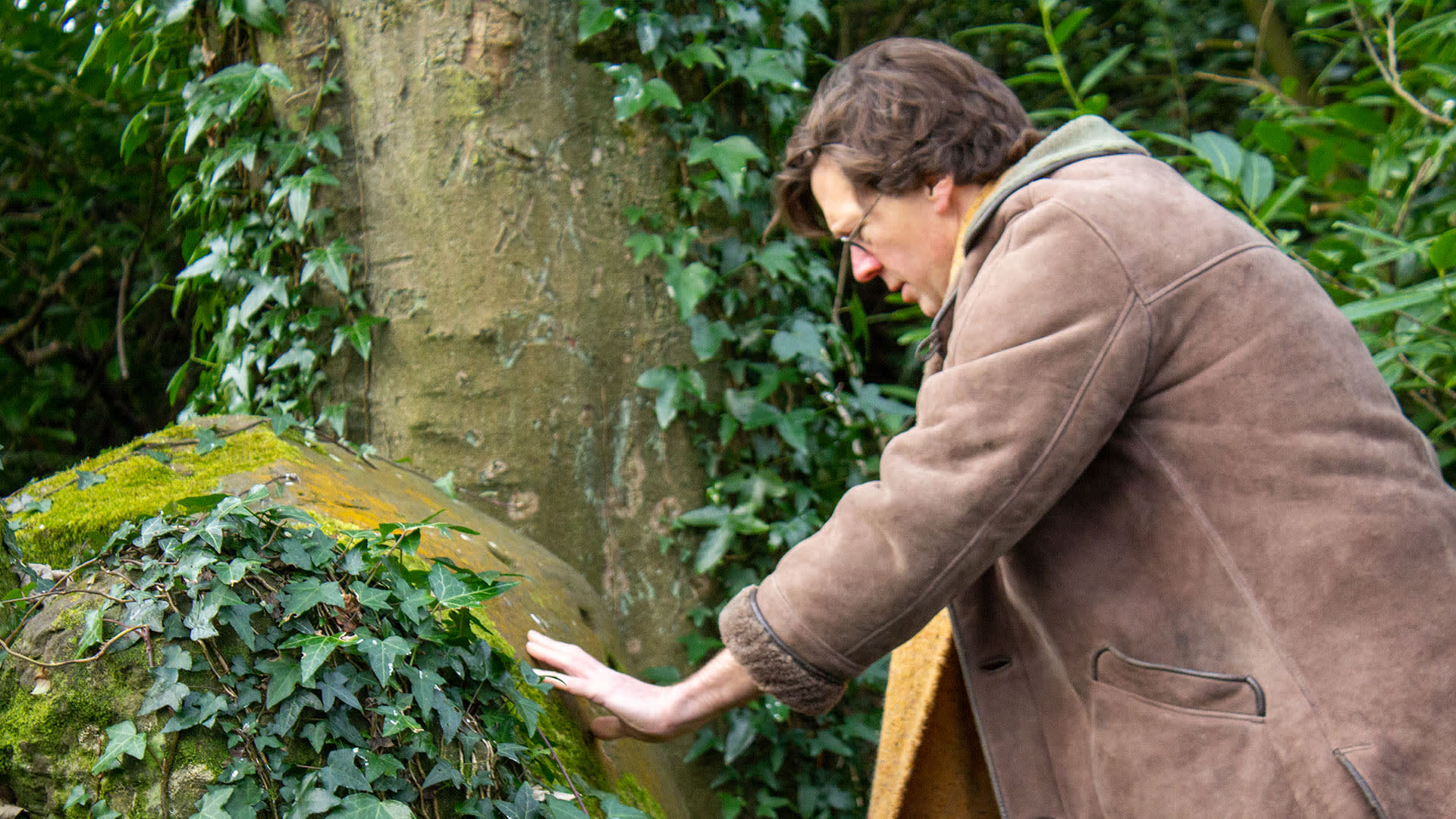
The Anchorite of Fore Abbey

scolairebocht

Moderator
Staff member
Member
Joined
Sep 11, 2021
Messages
1,333
Reaction score
1,683
This is a video on the Anchorite's Cell at Fore Abbey Co. Westmeath. An Anchorite took a special vow, to remain for the rest of his life enclosed in these small cells, awaiting his death.


Fr Patrick Beglin was easily the most famous of the Anchorites of Fore, and incidentally he is said to have come from the South East corner of Co. Westmeath, where there still are Beglins and still involved in the Church. At the time of Beglin, that is the last decades of the 16th and the early decades of the 17th century, it was owned by the Ussher family but rented out to the Nugents, of Donore I think, who I believe protected the anchorite:
"Edward Nugent charged for rent, House of Anchorets of Fower as assignee of Beland[?] Ussher."
(Easter term 36th year of Elizabeth I, hence c.1594, NAI Ferguson Mss vol ix, The first Book of Orders in the Office of the 2nd Remembrancer, 1592-1598, p.2.)
In any case he was certainly not the last anchorite, after him you had:
"Rev. Patrick Clonan, Rev. Mr. John Nugent, Rev. Charles Fagan, and in 1719 Rev. Mr George Fleming who died a few years later and was the last. Fleming was said to have died in 1741."
(Brian Nugent, Shakespeare was Irish! (Co. Meath, 2006-2020), p.156.)

There are a number of Anchorite cells in Ireland, one is attached to St Canice's Cathedral in Kilkenny for example, and at least one in the environs of Dublin described here, St Doulagh's of Balgriffin:
"He became an enclosed anchorite. He and his successors were built up in the chamber which was their cell, and never left it until death released them; but even then the body remained, for it was buried beneath the floor of the cell. The successor of the dead-immured hermit daily said his prayers standing over the place where the body of his predecessor lay, while beside the grave he dug a grave for himself, and kept it always open to remind him whither he was going.
Bishop Reeves in his memoir quotes a description of...these enclosed anchorites lived. It is from a Roman source of the twelfth century. The Roman colouring of it may therefore not apply to St. Doulagh:—
"The abode of an inclusus should be built of stone, measuring twelve feet in length, and as many in breadth. It should have three windows, one facing the choir, through which he may receive the body of Christ; another at the opposite side, through which he may receive his food; and a third to admit light, but which should always be filled with glass or horn. The window through which he receives his food should be secured with a bolt, and have a glazed lattice, which can be opened and closed, because no one should be able to look in, except so far as the glass will allow, nor should the recluse have a view out. He should be provided with three articles, namely, a jar, a towel, and a cup. After tierce, he is to lay the jar and cup outside the window, and then close it. About noon he is to come over and see if his dinner be there. If it be, he is to sit down at the window and eat and drink. When he has done, whatever remains is to be left outside for anyone who may choose to remove it, and he is to take no thought for the morrow.
But if it should happen that he has nothing for his dinner, he must not omit to return his accustomed thanks to God, though he is to remain without food until the following day. His garments are to be a gown and a cap, which he is to wear waking and sleeping.""
(Robert Walsh, Fingal and its Churches (Dublin, 1888), p.31-2.)

Why we seem to have only one continuing to function at the time of the Reformation and Counter Reformation is hard to say. Also its origin could be either from the time of St Fechin, this old Irish saint, like many others of his era, was noted for being a kind of hermit or anchorite, or it could have been created by the de Lacys when they built the nearby Benedictine Monastery c.1180, similar to one at a monastery of theirs in Wales.

Incidentally Westmeath also has another unique Catholic institution in that respect, because it also has the only monastery in Ireland which continued to function as a Catholic one all throughout the Reformation and Counter Reformation. This is the Franciscan convent of Multyfarnham, burned down and sacked many times by the English government but always built back again there or nearby and hence survived to this day.

In any case here is a description of the Anchorite in Fore from 1682:
"Fore...one church or cell of an Anchorite, the sole of the religious of this kind in Ireland. This religious person at his entry maketh a vow never to go out of his doors all his life after, and here he remains pent-up all his days, every day he saith mass in his chapel, which is part of, nay almost all his dwelling-house, there is no more house, but a very small castle wherein a tall man can hardly stretch himself length, if he laid down on the floor, nor is there any passage into the castle but thro' the chapel. He hath servants that attend him at his call in an out-house, but none lyeth within the church but himself. He is said by the natives, who hold him in great veneration for his sanctity, every day dig or rather scrape, for he useth no other tool but his nails, a portion of his grave; being esteemed of so great holiness, as if purity and sanctity were entailed on his cell, he is constantly visited by these of the Romish religion, who aim at being esteemed more devout than the ordinary amongst them; every visitant at his departure leaveth his offering or (as they phrase it) devotion on his altar; but he relieth not on this only for a maintenance, but hath those to bring him in the devotion whose devotions are not so fervent as invite them to do the office in person; these are called his proctors, who range all the countries of Ireland to beg for him, whom they call the holy man in the stone: corn, eggs, geese, turkies, hens, sheep, money and what not; nothing comes amiss, and no where do they fail altogether, but something is had, insomuch that if his proctors do honestly, nay if they return him but the tenth part of what is given him, he may doubtless fare as well as any priest of them all; the only recreation this poor prisoner is capable of, is to walk on his terras built over the cell wherein he lies, if he may be said to walk, who cannot in one line stretch forth his legs four times."
(Sir Henry Piers, Chorographical Description of the County of Westmeath (Tristernagh, 1682), in, Charles Vallancey, Collectanea de rebus hibernicis (Dublin, 1786) vol i, p.63-64.)
 
Last edited:
Excellent video considering I was there a few weeks back.
 
Do we have build dates for the 4 different constructions. And are these bones human bones.
 
Declan
Do we have build dates for the 4 different constructions. And are these bones human bones?

Yes I assume they are human bones, underneath the floor are the graves of previous anchorites, and under the chequered part graves of the Earls and Marquisses of Westmeath.

As regards build dates, they are not known exactly, at a guess:
- I would say c.1200 for at least some of the overall Benedictine Monastery in the bog that you can see (and later additions from that to when it was closed in 1540).
- You could take any date from c.1200-1500 for the castle looking part of the Anchorite's cell, and the entrance part was built onto twice, once c.1680 and then c.1850.
- St Fechin's Church could be as late at his time, maybe 700 AD roughly.
- St Mary's Church in Fore (in the graveyard of the modern Catholic Church) is Norman, about 1200s or 1300s


Myles O'Reilly
Do you think he's somewhat vain in that he keeps talking about his family and how great they were?

Maybe you are right, but its natural I would know more about my wider family and the history of the local area? And if its new and interesting information, which most people don't know already, then I think some people might be interested in it?

Some of it is family lore incidentally, my grandfather always told me that the last 'prior of Fore' was a Nugent, he never said abbot. Years later I realised that Fore was never elevated to the status of a separate monastery, with its own abbot, instead it was always just a branch, or 'priory', of the mother house in France.

Bocht, did this self incarceration serve any purpose?

As regards the point of it, well I am sure there are very technical theological issues at play here, but basically the sense of quiet and giving yourself completely to the contemplation of God, is considered a very holy thing to do. And of course what he is doing all the time is praying, and thats considered very important in the Catholic faith, who knows maybe it contributed to Irish people keeping the faith all those years?
 
No, thats Robert Nugent. His family are also one of the few Nugent families still in Westmeath or near there. I know him alright but am not related to him, except that he is another Nugent of course and members of the clan tend to stick together!lol I am Brian Nugent, from rural Meath but not too far from Fore.
 
Fair play Sir. I went to school with a few Nugents.

I'm guessing its a Norman name?
 

According to this , the church of Feichin, dates from before 665

So when the other monetary was built it was over 4 hundred years old and could be a ruin???

It is amazing anything is left if it is that old.
 
Yes there are many ancient lives of St Fechin, mostly in Latin but some in Irish, dating to about the 700s or 800s, so they could be mined for solid references to building work if anybody wanted to go down that road.
 
And remember you have also the crozier of St Fechin, i.e. an ornamental covering for the remains of the wooden crozier used by St Fechin. Actually I went into the National Museum a short while ago to see it, where it used to be on display, but its gone now, presumably in storage.
 
Yes its a Norman name of course, they were close relatives of Hugh de Lacy.

So again Fr Patrick Beglin was the priest here in Shakespeare's time, I don't know was he a friar as well but anyway I wonder does Shakespeare capture the atmosphere here a bit:

Eglamoure: "The Sun begins to guild the western sky.
And now it is about the very hour,
That Silvia, at Friar Patrick's Cell should meet me,
She will not fail; for Lovers break not hours,
Unless it be to come before their time.
So much they spur their expedition.
See where she comes: Lady a happy evening.
Silvia: "Amen, Amen, go on (good Eglamoure)
Out at the Posterne by the Abbey wall;"
(Two Gentlemen of Verona, Act 5 Scene 1.)
 
I heard Shakespeare was from Co Kildare and was related to Silken Thomas.
 
Are you saying Fr Beglin was Shakespeare or some lad that passed there was Shakespeare.
 
No Fr Beglin wasn't, but its a kind of truism to say that Shakespeare does have some strange insights into Irish society that are unexpected and a bit hidden, like his Catholicism as well.
 
No, thats Robert Nugent. His family are also one of the few Nugent families still in Westmeath or near there. I know him alright but am not related to him, except that he is another Nugent of course and members of the clan tend to stick together!lol I am Brian Nugent, from rural Meath but not too far from Fore.
Nugent is a protestant name of English /French origin. They were land lords and the town of Mount Nugent is called after them.
 
No Fr Beglin wasn't, but its a kind of truism to say that Shakespeare does have some strange insights into Irish society that are unexpected and a bit hidden, like his Catholicism as well.
And it should be noted that he could not have had the insights into Denmark without being there , which "he" never was
 
Bocht, Fore Abbey was on a TG4 show about holy wells called Ag Triall ar an Tobar.

I recognised it straight away from your video.

I didn't know about the 7 miracles nor the guy who conducted the Ordnance Surveys 200 years ago As Gailge.
 
Yes, the "Holy man in the stone" is one of the miracles, and thats the Anchorite. I think with the Ordnance survey you are probably thinking of John O'Donavan, it was his job to check the Irish placenames and make sure they made sense as renditions of the Irish. His letters, from all over Ireland but yes the Westmeath ones are very interesting, are well known to local historians.
 
No Sir. I know of John O'Donovan. A very good series was done on him a couple of years ago by John Creedon.

This was another individual who had a Gaelic name.
 
My apologies Bocht. I've gone to TG4 Player to find the episode and it was of course John O'Donovan.

I should have known.

But in my sleepy stupor I didn't notice the Irish name was Seán Ó Donnabháin!

The Link to the episode is below. The piece on Fore Abbey begins at 17mins.

 
Yes very interesting Myles. Basically Christian spirituality is to be laughed at in Ireland but any Pagan roots you can find are to be glorified. Its the transition the Occult world want to make here!

Yes O'Donovan was there c.1840 but more interestingly another traveller, I think it was Isaac Butler, was there, in Fore, I think in 1744. He said the last of the Anchorites only stopped a few years before but he also said that for some reason Protestantism could never flourish there, only Catholicism. His travels are published in numerous places, but for some reason that reference I only got from the original manuscript of his travels in Armagh, its not in the published account.
 
In 1744, the addition was not there, just the two story part. Do we know when that was built. Is t known how many anchorites there were. How long they lasted and if there were ever two at the same time.
 
But remember that part had also been rebuilt by the Earl of Westmeath c.1680, so some of it was there then.

Well the list of Anchorites that you see above for c.1600 to 1741 was from Patrick Lynch's book on St Patrick of about 1830, via Fr John Brady's notes on Meath history, where I got the reference. I cannot remember if he has a fuller list and I never knew where Lynch got his list from.

Patrick Lynch was a kind of rural polymath from about Tipperary, if I remember right, an expert on astronomy and Mathematics etc never mind history, all hedge school and personal education. He, and his son William, were then employed by the Irish Record Commission c.1820, I suspect for their knowledge of Latin as well as Irish history. All of those old hedge school masters were great Classical scholars.
 
Last edited:
So 5 anchorites that we know of. Very interesting, the last lad dying in 1741
 
Yes but probably, well definitely, there were earlier ones. This is where that list comes from and I don't know any other source for this information.
I presume with these references Lynch might have visited Fore, or corresponded with somebody from there:
"Ware, in the 5th section of the 35th chapter of his Antiquities, observes, that the Irish hermits were called Inclusi, because they shut themselves up in their cells and hermitages;
yet their confinement was not so strict, but by dispensation they might leave them, except that of St. Fechin's, in Foure, or Baille-leabar, i.e. the City of Books, a description of which is contained in the lines underneath:
Quae capit a Iibris nomen, celebrata perenni
Fama, Ires jactat villa forea dotes.-.
Hic stat sacra domus, glauca constructa palude,
Hic monstrat patulos. Anarchoreta lares,
Vertitur hic nullo pellenti flumine rota,
Quae tria sunt longa concelebranda die.

The anachoretical cell of Foure, the oratory of which is the burial place of the earl of Westmeath, was inhabited longer than any of the others in Ireland; for, in 1616, died there the Rev. Patrick Beglin, whose monumental inscription we here subjoin:
En ego Patricias Beglin sacra incola Eremi
Hoc fapidurn tumulo condor humorque cavo,
Rupe sub aeria, monumento et sede Sacrata,
Intemerata adyto, tum sine labe domo,
Quisquis is est ergo qui cernit busta viator
Dicat Eremicolae spiritus astra petat.

After the death of Mr. Beglin, the Rev. Mr. Daly became anchoret at Foure; and after he died, the Rev. Patrick Clonan; after him the Rev. Mr. John Nugent, who was succeeded by the Rev. Mr. Charles Fagan; and in 1719, the Rev. Mr. George Fleming resigned the parish of Castletown-Delvin, which for many years he served, and retired to the eremetical cell of Foure, where, in three or four years after, he died; since which time, there has not been an anchoret there, nor do we know any other cells of this nature in Ireland, except Lismore and Kilkenny. In the registry of Octavian de Palatio, archbishop of Armagh, there is mention made of an Observantine Franciscan, who, having lost his sight, was, on the 10th of July, 1508, admitted by the archbishop to lead the life of an anchoret, near the cathedral of Cashel, where he had built himself a cell in the wall; and the archbishop granted forty days' indulgence to those who should give aid in finishing it. Ware also informs us, that the rules for regulating the anchoret's lives to have been extant in a manuscript, formerly belonging to St. Thomas's abbey in Dublin, to which is annexed an epistle of one Robert, a priest, to Hugh, an anchoret, written about the reign of Henry the II."
(Patrick Lynch, The Life of Saint Patrick (Baltimore, 1854), p.157-158.)
 
Last edited:
Yes thats true, there was a Famine around that time. You know an interesting thing about the earlier Irish Famines is that when we had a native parliament, albeit a very controlled one, before the Act of Union, they always banned the export of food out of Ireland at those times. You can read that in the proclamations they issued, and frequently banned giving human type food to horses, to preserve it for humans, as well.
 
To give you some idea of the erudition of Patrick Lynch, to whom we owe that Anchorite list, one of the great of the poor scholars of Ireland, here is a list of his works:

Paddy's Portable Chronoscope
Carrick-on-Suir, 1792.

The Pentaglot Preceptor; Or Elementary Institutes Of The English, Latin, Greek, Hebrew, And Irish, Languages
Carrick-on-Suir, 1796

A Plain, Easy and Comprehensive Grammar, Of The English Tongue
Carrick-on-Suir, 1805

Lady's 1810
[a kind of Almanack], Dublin, 1810

Wogan's Pocket-Calendar for 1810

Dublin, 1810.

Historical Account of Irish Almanacks
published in Cox's magazine in 1810

The Elements Of Euclid, Viz. The First Six Books, edited by Lynch
Dublin, 1810

A Treatise On Practical Surveying
Dublin, 1810, edited by Lynch

The Life Of Saint Patrick, Apostle Of Ireland
Maynooth, 1810

Lynch's improved edition of Wettenhal's Greek Grammar.

Foras Feasa air Eirinn, for an edition of Keating's work, he wrote the life of Keating in it.
Dublin, 1811

Life of Columkille
Dublin, c.1814

The Earl Of Castlehaven's Memoirs, he contributed a life of the author
Dublin, 1815

An Introduction To The Knowledge Of The Irish Language, As Now Spoken
Dublin, 1815

The Classical Student's Metrical Mnemonics, Containing, In Familiar Verse, All the necessary Definitions and rules Of The English, Latin, Greek, And Hebrew Languages
Dublin, 1817

An Easy Introduction To Practical Astronomy, And The Use Of The Globes
Dublin, 1817

A Geographical & Statistical Survey Of The Terraqueous Globe, Including A Comprehensive Compend Of The History, Antiquities And Topography Of Ireland
Dublin, 1817

Hibernia Sancta, or Lives of Irish Saints
Dublin, 1817

A Biographical and Historical Dictionary, Of Illustrious Irish Characters
Dublin, 1815

An Essay on Education, including Strictures on Feinaigle's System
Dublin, 1817

Description of Dublin, Prefixed to Fleming's edition of the "Postchaise Companion."
Dublin, 1817
(Journal of the Waterford and South East of Ireland Archaeological Society, vol xv (Waterford, 1912), p.107-117.)
 
This is a video on the Anchorite's Cell at Fore Abbey Co. Westmeath. An Anchorite took a special vow, to remain for the rest of his life enclosed in these small cells, awaiting his death.


Fr Patrick Beglin was easily the most famous of the Anchorites of Fore, and incidentally he is said to have come from the South East corner of Co. Westmeath, where there still are Beglins and still involved in the Church. At the time of Beglin, that is the last decades of the 16th and the early decades of the 17th century, it was owned by the Ussher family but rented out to the Nugents, of Donore I think, who I believe protected the anchorite:

In any case he was certainly not the last anchorite, after him you had:


There are a number of Anchorite cells in Ireland, one is attached to St Canice's Cathedral in Kilkenny for example, and at least one in the environs of Dublin described here, St Doulagh's of Balgriffin:


Why we seem to have only one continuing to function at the time of the Reformation and Counter Reformation is hard to say. Also its origin could be either from the time of St Fechin, this old Irish saint, like many others of his era, was noted for being a kind of hermit or anchorite, or it could have been created by the de Lacys when they built the nearby Benedictine Monastery c.1180, similar to one at a monastery of theirs in Wales.

Incidentally Westmeath also has another unique Catholic institution in that respect, because it also has the only monastery in Ireland which continued to function as a Catholic one all throughout the Reformation and Counter Reformation. This is the Franciscan convent of Multyfarnham, burned down and sacked many times by the English government but always built back again there or nearby and hence survived to this day.

In any case here is a description of the Anchorite in Fore from 1682:

Did that guy actually say "St Feckin's church"?


lol
 
Thats the saints name, St Fechin, although you would really not pronounce the c.
 
Last edited:
This is the 1744 account by the traveler Isaac Butler on his visit to Fore:
"This water is exceedingly clear and sweet, and comes as they relate by a subterranean passage from Lough Lene under the great rock and there discharges.
The saying of the people of Fore:
An abbey in a bog
A mill without a stream
An anchorite in a rock.
...
The last Anchorite who lived here was George Fleming, he is three years dead, since which time the place has gone entirely to decay.
...
They have a strange aversion to Protestants (being all Roman Catholics) and withal assured me that no of that profession could ever thrive here. A large house near the Westgate, which was built on purpose to introduce the making of linen by Protestant persons was quickly deserted, and demolished, as I suppose by the wicked neighbours they has to deal with. It has the character of being inhabited at present by the greatest reprobates in the kingdom and I was afterwards informed that I has a happy deliverance that no quarrel happened, wherein they generally bring in a stranger for the cause of it."
(Isaac Butler, Itinerary of Journeys through the Counties Dublin, Meath and Louth, 1744, Original Mss in Armagh Public Library, p.96-98.)
 
No Fleming, like Nugent, is a great Norman name of the general Meath area. All these families were very determined and committed Catholics but as the Penal Laws wore on, some changed to preserve their wealth and these Protestant families are the ones many people know from the 19th century. But most of all these families stayed Catholic, and descended into an obscure poverty as a result.
 
An example of that conversion here in Fingal would be the Talbot family who owned Malahide castle up until the 1970's.

The Talbots backed the wrong horse at the Boyne - four of their sons were killed there - and subsequently converted to Protestantism to retain their lands.

However, as was the case with a lot of these conversions, they maintained a bond with the old religion and the jobs in and around the estate were often given to local Catholics (eg the O'Neill family were the gatekeepers at Malahide right up until the end).

Some Anglo-Irish Gentry used to believe these families made a kind of false conversion and secretly held mass in their houses/castles.
 
How can you possibly say they 'backed the wrong horse', the Irish Nationalist Catholic cause is at all times the 'right horse' irrespective of the outcome!

I don't know about 'secret masses' but certainly sometimes the new Protestant families helped the Catholic ones. For example the vestments of St Oliver Plunkett were retained carefully, I think, by the Dunsany family of the Plunketts, and they are the Protestant branch of this very proudly Catholic family.
 
They can't be a very proudly Catholic family if some of them converted Sir.
 

Latest Threads

Popular Threads

Back
Top Bottom