
Donald Trump.

Oh ffs, just use Google Jambo.

Every major historical migration wave follows this pattern due to self correcting economic, social, and political forces (negative feedback).
  • Economic equilibrium: High migration usually starts because of a wage gap between two countries. As workers leave the home country, labor shortages there cause local wages to rise. Meanwhile, wages in the destination country stabilize. The economic incentive to move naturally shrinks.
  • Demographic shifts: Sending countries eventually run out of young, mobile citizens. For example, falling birth rates in historical source countries (like Italy in the mid-20th century or Mexico in the early 21st century) naturally reduced the pool of potential migrants over time.
  • Political backlash: Rapid, exponential growth in immigration often triggers social friction. This leads destination governments to implement stricter laws, quotas, or border controls, placing an artificial cap on the growth curve.
  • Diaspora saturation: Early migrants help newcomers find jobs and housing. Once the diaspora community faces its own economic limits or housing shortages in destination cities, that support network strains, slowing down new arrivals.
Historical Examples
  • The Irish & Italian Waves (US): The massive influx into the United States in the late 19th and early 20th centuries did not expand forever. It was capped by a combination of improving conditions in Europe and the US Emergency Quota Act of 1921.
  • The Mexican Migration Wave (US): For decades, net migration from Mexico to the US grew rapidly. It peaked around 2007 and then leveled off—and sometimes reversed—due to demographic aging in Mexico and changing economic conditions.
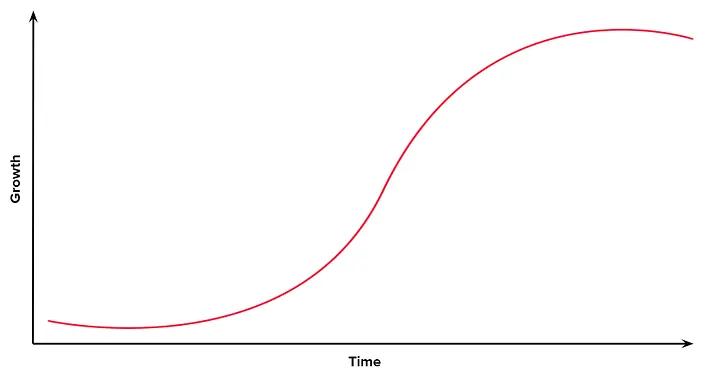
This same pattern is observed all throughout nature, and the social and political and economic world.

It's called the "s-curve" or sigmoid curve.

It's seen in all growth.

1*AGuIwXoUZvG5m4eYpxcZEQ.png
 
Oh ffs, just use Google Jambo.

Every major historical migration wave follows this pattern due to self correcting economic, social, and political forces (negative feedback).
  • Economic equilibrium: High migration usually starts because of a wage gap between two countries. As workers leave the home country, labor shortages there cause local wages to rise. Meanwhile, wages in the destination country stabilize. The economic incentive to move naturally shrinks.
  • Demographic shifts: Sending countries eventually run out of young, mobile citizens. For example, falling birth rates in historical source countries (like Italy in the mid-20th century or Mexico in the early 21st century) naturally reduced the pool of potential migrants over time.
  • Political backlash: Rapid, exponential growth in immigration often triggers social friction. This leads destination governments to implement stricter laws, quotas, or border controls, placing an artificial cap on the growth curve.
  • Diaspora saturation: Early migrants help newcomers find jobs and housing. Once the diaspora community faces its own economic limits or housing shortages in destination cities, that support network strains, slowing down new arrivals.
Historical Examples
  • The Irish & Italian Waves (US): The massive influx into the United States in the late 19th and early 20th centuries did not expand forever. It was capped by a combination of improving conditions in Europe and the US Emergency Quota Act of 1921.
  • The Mexican Migration Wave (US): For decades, net migration from Mexico to the US grew rapidly. It peaked around 2007 and then leveled off—and sometimes reversed—due to demographic aging in Mexico and changing economic conditions.
This same pattern is observed all throughout nature, and the social and political and economic world.

It's called the "s-curve" or sigmoid curve.

It's seen in all growth.


1*AGuIwXoUZvG5m4eYpxcZEQ.png
 
I said Islamist Ideology as a whole and not the particular Sunni subset is he speaking about there- particularly when your main Islamist enemy is the IRGC.
Oh would you ever shut the fuck up with your continuous factionising everything and anything. And pulling endless nonsense out of your crusty hole. The Professor was talking about it all - including people like you and Jambo (I've bolded those parts to make his message clearer for you).

"... Commenting on what he called the "culture of hatred," Prof. Abd Al-Hamid Al-Ansari, former Dean of Islamic Law at Qatar University, called to interpret the Quranic texts "in a progressive, humanistic way" in order to shield the youth from ideological fanaticism and to break away from the "discriminating, fanatic, and racist aspects" of our past.

Prof. Al-Ansari, speaking on Sky News Arabia on August 5, said that while terrorism is often described as a reaction to political injustices, "this is not true. It's an illusion. Terrorism is an action, not a reaction."

Abd Al-Hamid Al-Ansari: The roots of the culture of hatred, or the rhetoric of hatred, go way back, to the days of the kharijites, the first terrorist organization, which rebelled against the best Islamic society, the society of the companions of the Prophet Muhammad. The culture of hatred has numerous roots: erroneous religious notions, like the distorted concept of Jihad prevalent today, the concept of "loyalty and disavowal," which is, in fact, hatred of people who subscribe to other religions [including secular political religions or ideological adherents - roc_].

Interviewer: Aren't there prominent religious texts that... You are a professor of shari'a, and former Dean of Islamic Law at Qatar University... Don't we have a problem with some religious texts, which are hostile towards the other?

Abd Al-Hamid Al-Ansari: Texts can be interpreted in various ways. You can interpret texts in a progressive, humanistic way, especially the Quranic texts. The Quran is meant to instill values and morals and to prevent injustice. We all know that. But texts are always formed within a specific social reality.

Abd Al-Hamid Al-Ansari: I believe that the arts, especially music, make the soul more humanistic. The arts are a means of shielding our sons against the ideology of extremism, because music makes you love life. All forms of art make you love people, love life. They make you more humane, more tolerant. If you manage to instill this within the minds of the youth, you shield them from ideological fanaticism. you shield them from ideological fanaticism. Fanaticism takes control over people who hate life, whose hearts are empty.

Abd Al-Hamid Al-Ansari:Our main obstacle, in my opinion, is our clinging to the past, to our heritage. The Arab individual is programmed to glorify the past. We are unable to break away from our heritage of fanaticism. I am not saying that we must break away from our past - only from its negative and inhumane aspects, its discriminating, fanatic, and racist aspects.

Abd Al-Hamid Al-Ansari: Any great scholar or jurisprudent who died 1,000 years ago is glorified, and people cling to his sayings, even though these sayings - his rulings, his fatwas - were solutions to problems of his days. If he banned music or the construction of churches, should I ban them too?

Abd Al-Hamid Al-Ansari: Terrorism is an action, not a reaction..."
 
Oh would you ever shut the fuck up with your continuous factionising everything and anything. And pulling endless nonsense out of your crusty hole. The Professor was talking about it all - including people like you and Jambo (I've bolded those parts to make his message clearer for you).

"... Commenting on what he called the "culture of hatred," Prof. Abd Al-Hamid Al-Ansari, former Dean of Islamic Law at Qatar University, called to interpret the Quranic texts "in a progressive, humanistic way" in order to shield the youth from ideological fanaticism and to break away from the "discriminating, fanatic, and racist aspects" of our past.

Prof. Al-Ansari, speaking on Sky News Arabia on August 5, said that while terrorism is often described as a reaction to political injustices, "this is not true. It's an illusion. Terrorism is an action, not a reaction."

Abd Al-Hamid Al-Ansari: The roots of the culture of hatred, or the rhetoric of hatred, go way back, to the days of the kharijites, the first terrorist organization, which rebelled against the best Islamic society, the society of the companions of the Prophet Muhammad. The culture of hatred has numerous roots: erroneous religious notions, like the distorted concept of Jihad prevalent today, the concept of "loyalty and disavowal," which is, in fact, hatred of people who subscribe to other religions [including secular political religions or ideological adherents - roc_].

Interviewer: Aren't there prominent religious texts that... You are a professor of shari'a, and former Dean of Islamic Law at Qatar University... Don't we have a problem with some religious texts, which are hostile towards the other?

Abd Al-Hamid Al-Ansari: Texts can be interpreted in various ways. You can interpret texts in a progressive, humanistic way, especially the Quranic texts. The Quran is meant to instill values and morals and to prevent injustice. We all know that. But texts are always formed within a specific social reality.

Abd Al-Hamid Al-Ansari: I believe that the arts, especially music, make the soul more humanistic. The arts are a means of shielding our sons against the ideology of extremism, because music makes you love life. All forms of art make you love people, love life. They make you more humane, more tolerant. If you manage to instill this within the minds of the youth, you shield them from ideological fanaticism. you shield them from ideological fanaticism. Fanaticism takes control over people who hate life, whose hearts are empty.

Abd Al-Hamid Al-Ansari:Our main obstacle, in my opinion, is our clinging to the past, to our heritage. The Arab individual is programmed to glorify the past. We are unable to break away from our heritage of fanaticism. I am not saying that we must break away from our past - only from its negative and inhumane aspects, its discriminating, fanatic, and racist aspects.

Abd Al-Hamid Al-Ansari: Any great scholar or jurisprudent who died 1,000 years ago is glorified, and people cling to his sayings, even though these sayings - his rulings, his fatwas - were solutions to problems of his days. If he banned music or the construction of churches, should I ban them too?

Abd Al-Hamid Al-Ansari: Terrorism is an action, not a reaction..."

He makes clear that he is talking about Arabs, also Ansar Allah do not glorify the past, anyway though the fact is outside of the it's usage for propagandizing in favour of Zionism to Western and Christian audiences you as interested in contemporary Islamic Political and social more broadly as Jambo is interested in the literature of West African women who identify as "Lesbian".
 
He makes clear that he is talking about Arabs...
But its applicability to the likes of you and Jambo is stark. E.g.

"Fanaticism takes control over people who hate life, whose hearts are empty."

This Professor is undoubtedly wise, that is why his words tend to the universal.
 

Latest Threads

Popular Threads

Back
Top Bottom