
- Joined
- May 10, 2026
- Messages
- 1,150
- Reaction score
- 517


Who is the observer?Except I never ever mentioned "human consciousness" or specified the observer at all.
You had to especially add in that to "win" your little point, didn't you.
I did not specify it because I am familiar with the particular experiment you are referring to and its results.
I additionally did not specify it because what I had in mind was the phenomenon in quantum mechanics where you can have two quantum particles separated by vast distances, and the act of "observing" the properties of one particle instantly correlates to the state of the other.
It acts as though the two particles are two ends of the exact same thing rather than communicating across space.
So the observer "figures strongly" because any act of observation requires interacting with and becoming entangled with what is being measured. I.e., observation and entanglement are deeply connected.
“We are made of the same stardust of which all things are made, and when we are immersed in suffering or when we are experiencing intense joy we are being nothing other than what we can’t help but be: a part of our world.” ― Carlo Rovelli, Seven Brief Lessons on Physics
Jambo, you're a moron, but just this once.[Who] is the observer?
lol There isn't a the observer, there is an observationJambo, you're a moron, but just this once.
Try to understand that my reference point is not your slit experiment.
If you actually wanted to understand my reference point well you might try and read A.N Whitehead's "process philosophy" (that is a foundational metaphysical framework for understanding quantum physics.)
In that framework "the observer" is not seen as a separate human consciousness measuring lifeless matter. Rather the framework sets out how the universe is made of active, interwoven events ("actual occasions") that are inherently relational and experiential.
Vis, reality is not built of static particles, but of momentary "events" that come into being, integrate the potential of the past, and "perish" to provide possibilities for the future.
So this framework mirrors quantum mechanics, where physical entities act like waves of potential until an interaction ("event") actualises a specific state.
So "the observer" is in effect a "principle of determination" - The observer in this framework is not necessarily a human subject, but rather the principle of determination that collapses a wave of possibilities into an actual, measurable event.

Anti-racism is an example.“Anti-racist is a code word for anti-white.”
Is normal everyday language not sufficient to communicate that you’re unhappy about the number of coloured people coming to the country and to explain how it bears on your interests, and on your political concerns?
Obviously not.
Which raises the question of why you choose to communicate using this type of jargon and Orwellian manipulation and weaponising of language clearly designed to limit the range of human consciousness and thought itself.
I would say a question become even more exigent for our society to deal with than even the immigration question itself. - What you and your foreign friends are trying to do to language is a phenomenon often observed at the root of a totalitarian tendency.
I discussed this just the other day with Haven -Just looked up that MP using this jargon on wiki.
One thing jumped out. If he so against what he calls “anti-white” then why did he anti-white his whole face?
Very very strange.
View attachment 9035


Why do you keep harping on about jargon? Most of the discourse around race is filled with leftist jargon.Which raises the question of why you choose to communicate using this type of jargon and Orwellian manipulation and weaponising of language clearly designed to limit the range of human consciousness and thought itself.
He doesn't really have much else, does he. And when he comes up with his own "arguments", they're invariably moronic.Why do you keep harping on about jargon?

Most of the discourse around race is filled with leftist jargon.
The word "racism" itself was made popular by Magnus Hirschfeld of the Institute of Sexual Research, who performed the first transgender operations. Why do you use Jewish jargon from the 1930s?
Here's more libtard jargon:
- anti-racism
- white privilege
- hate speech
- critical race theory
- people of colour
- her body, her choice
- controlling a woman's body
- systemic racism
- right wing dog whistle
- intersectionality
- homophobic
- Islamophobic
- pregnant people
- toxic masculinity
- mansplaining
Give us some examples then..You might note on the transmigration thread yesterday, where I shared with this site's members that I was banned for life more than twenty times on the Irish leftie forum gubu.ie, I never failed to rail against their pernicious jargon and catchcries and consequent absence of adequate thought in progressive left circles, either.

In this I am an equal opportunity critic and challenger of ideologues, religious, and secular, left and right. That list of yours is absolutely spot on. But it doesn't negate the very similar list that your far right uses.
Okay, but you still use jargon such as "racist", "racism", "white supremacy" in nearly every post. This is not helpful to discussion, especially as no one here is a white supremacist. We might be racist but only in the sense that we recognise that races are different and we would prefer Ireland to not be filled with people of very different races, cultures and values which clash horribly with ours.You might note on the transmigration thread yesterday, where I shared with this site's members that I was banned for life more than twenty times on the Irish leftie forum gubu.ie, I never failed to rail against their pernicious jargon and catchcries and consequent absence of adequate thought in progressive left circles, either. In this I am an equal opportunity critic and challenger of ideologues, religious, and secular, left and right. That list of yours is absolutely spot on. But it doesn't negate the very similar list that your far right uses.
"Far Right"You might note on the transmigration thread yesterday, where I shared with this site's members that I was banned for life more than twenty times on the Irish leftie forum gubu.ie, I never failed to rail against their pernicious jargon and catchcries and consequent absence of adequate thought in progressive left circles, either. In this I am an equal opportunity critic and challenger of ideologues, religious, and secular, left and right. That list of yours is absolutely spot on. But it doesn't negate the very similar list that your far right uses.

lol ShamelessGive us some examples then..
Will we find that they're all antisemitic?
Hermit’s list is a good one.Give us some examples then..
Will we find that they're all antisemitic?

 www.jpost.com
Is anti-judaism not a more accurate word than anti-semitism?there is a fine line between stupidity and antisemitism - you never know where the line begins and ends.
This is a favourite tactic of the left as well.Is anti-judaism not a more accurate word than anti-semitism?

He came out of the closet yesterday.Roc, honestly, what on earth is the story with your avatar?
From long observation, I firmly believe that Jambo's* deep psychological issues that makes him susceptible to white supremacist ideology are ultimately sexual.Roc, honestly, what on earth is the story with your avatar?
What drugs are you on today?From long observation, I firmly believe that Jambo's* deep psychological issues that makes him susceptible to white supremacist ideology are ultimately sexual.
In truth he feels inferior to the black man, he feels inadequate, conscious of not being able to attract and satisfy women in the same way as the black man who he daily loudly insists that he is superior to - in intelligence, culture, and everything else he jibbers on and on about.
So I posit that Jambo notices my avatar and feels these insecurities and many inferior complexes niggling at him from his subconscious. The two white and anti-white dogs accompanying this black man also serve to reflect archetypes lying deep in Jambo's subconscious.
* And others on here.
Did you not understand the request?Hermit’s list is a good one.
But of course you could add all the leftist (and rightist) antizionist/antisemitic stuff.
For instance “Free Palestine” is jargon (and an idiom) just like many of your phrases.
It certainly doesn’t mean what it seems to mean taking an “outsider” clear view.
For illustration, if it did mean what it seems to mean, it would be analogous to “Free Iran.” But it means the opposite.
I.e. Freeing Iran means fighting an Islamofascist Islamicist dictatorship. Whereas “Freeing Palestine” you are fighting on behalf of this very same Islamicist dictatorship that is in effective power in Gaza and in the ascendant in the West Bank!
As for characterising such manipulation of language as “antisemitic”. I have often made the points that:
(a) there is a fine line between stupidity and antisemitism - you never know where the line begins and ends.
(b) antisemitism is a mass psychosis, it is a phenomenon of a crowd of people, of a great number of individuals formed into a single mass, and possessed by the madness of a crowd. It seems to well up from something like a “collective unconscious”.
So sure your own crowd and the leftist crowd differ in some important regards. (I have often said the left is the yin to the yang of your crowd such as we find on this forum.)
But it is fascinating the commonality you have with them, this coming together on antisemitism - and I find that terribly interesting.
I think it is the central key to understanding and unravelling the ignorance, stupidity and pathological elements that both movements exhibit.
It's very Jewy as well, isn't itWhat drugs are you on today?
, psychology-wise.
And this is why I made these two posts the other day..Did you not understand the request?
Speaking of the "Irish leftie forum gubu.ie", you said - "I never failed to rail against their pernicious jargon and catch cries"
You were to provide examples, can you do that?
 I see that roc hasn't mounted any defence for his lies.
When I listen to people on this forum, same as when I listen to people on the likes of gubu.ie, I sometimes sympathetically picture you as just like the indoctrinated children in this article. The same type of sentiments, forces, pied pipers, naivety, ignorance, susceptibility, projections, etc, are involved. See the photo. That’s it.
Another Tack: That unwitting indecency | The Jerusalem Post
To deny a grotesque double standard against Israel is either to misperceive reality or to deliberately misrepresent it for narrow political purposes.
I really think the Israel issue is a prism to help understanding about what is really going on within such crowds and their mass thinking.
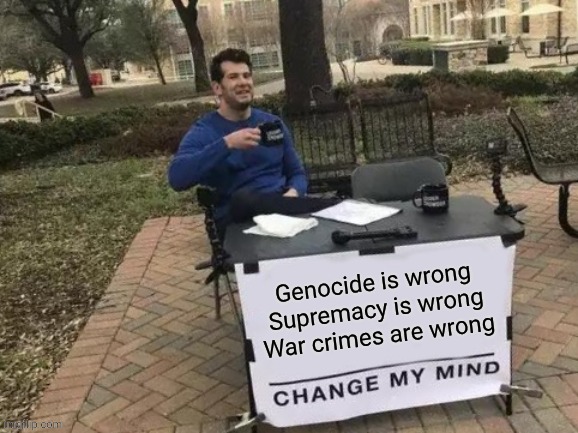
I'm like Mystic Mac - I predict dese tingsThis'll get him talking..

The tactics of you and Gollum. I.e. The loaded false premise.
Israel has been accused of "genocide" since late-Soviet communist propaganda set these slogans in motion - racism, genocide, imperialism, colonialism, apartheid.
Yet the Palestinian population has boomed notwithstanding all through these years.
Each of the Hamas wars they cried "genocide" if you recall.
David Duke and many on the far left were shouting “genocide” the same week as 7/10.
10 Questions 'Genocide in Gaza' Accusers Cannot Answer:
View: https://x.com/aizenberg55/status/1957443108397781234?s=46
South Africa of course stood down and sought an effective 36-month extension, pushing filings in The Hague to 2029 and beyond.
The ICJ likewise. They have no case.
And the ICC.
View: https://x.com/simopillon/status/2053751522572341473?s=46
Or if you were interested there are endless reports revealing that anti-Western antizionist factions were receiving millions in funding from China, Qatar, Russia, and radical groups.
I could go on.
But you see you have to wear “the green jersey”. You have to go along with the Irish left, who for years now, have taken the side of the worst regimes in the world and including open support and sympathy for the barbaric mullahs expressed by our President and others.
And a media that doesn't allow for any dissenting voice on this narrative so that for most people in this country such facts come as complete fucking news to them.
I agree, please continue..And I’ve hardly started.
One thing is sure though, no one in this country will admit it.
Like that Irishman in the UN claiming 14,000 babies would die in 48 hours if Israel didn’t open the crossings.
Despite the UN later being forced to admit the gross misrepresentation, was anything ever said?
Just one instance out of hundreds.
Genocide my hole.
Same as the other litany of accusations that rationalise the uprising sentiment.
I'd say it's LSD.I guess though the question for you Jambo and your compadres on this forum, and I guess this also may be where Tommy Robinson is coming from - is where the hell is your sympathy for this Islamo-left totalitarian cause and their lies ultimately coming from?
Well I think particularly you can see through the posts of the likes of @Diarmuid, and others, that antisemitism is also a politics and a zeitgeist - it's a conspiracy theory that fuels mass hysteria about Jewish power.
And I guess that's exactly what you and your compadres on here ultimately want, isn't it. - You want the mass hysteria. You know that conspiracy theories destroy a rational society. You want to pull it all down.
I.e. You want fascists in power who will march non-whites onto trains and planes notwithstanding their howls of terror to get rid of them from the country.
You want an economy reduced to barter, shotguns, gold and beans.
And you want your enemies put up against the wall. - As you yourself once expressed it on this forum, recall:
"... you better be prepared to take up a gu.. eh, sorry, don't want to say anything illegal. That's it, it's Game Over. I have no hope left. But if you want.. You better stop being scared about fucking talking about it.. because you're a racist. And every (subversive) geebag, who ever used that term (I know literally dozens on Irish political fora) will, when the glorious time comes, be put up against a wall and held accountable. May God have mercy..." (@The Equalizer)
And towards that you also are prepared to side with those who were previously your enemy?
Because you have an even greater enemy?
How do you think this is all going to end, Jambo.

Jewish LSDI'd say it's LSD.
What?From long observation, I firmly believe that Jambo's* deep psychological issues that makes him susceptible to white supremacist ideology are ultimately sexual.
In truth he feels inferior to the black man, he feels inadequate, conscious of not being able to attract and satisfy women in the same way as the black man who he daily loudly insists that he is superior to - in intelligence, culture, and everything else he jibbers on and on about.So I posit that Jambo notices my avatar and feels these insecurities and many inferior complexes niggling at him from his subconscious. The two white and anti-white dogs accompanying this black man also serve to reflect archetypes lying deep in Jambo's subconscious.* And others on here.


